Bulldozer vs. motor grader: telling them apart in overhead imagery
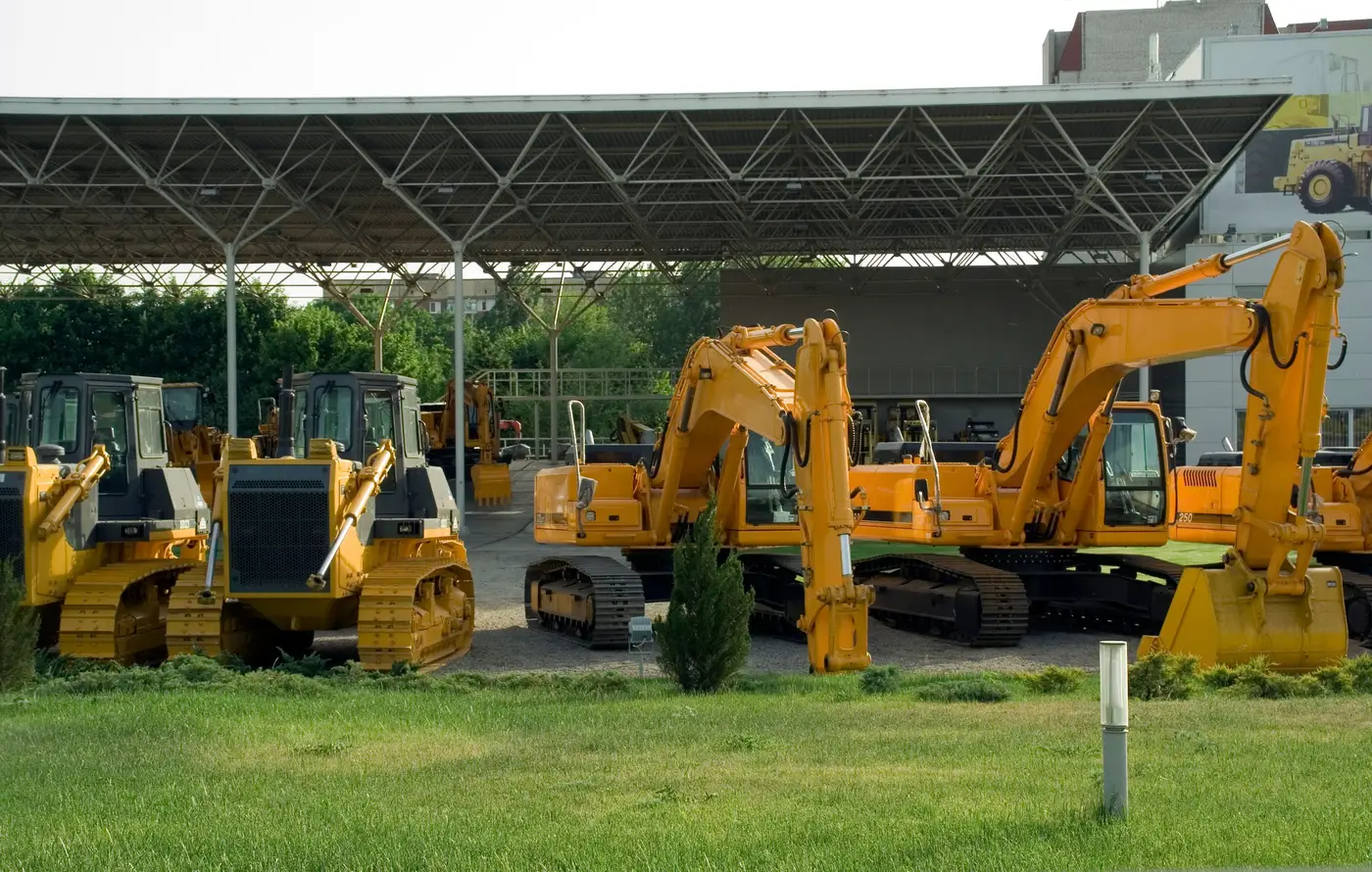
If you've spent any time counting machines off satellite imagery, you know the two that get confused most often aren't the excavator and the loader. It's the bulldozer and the motor grader. Both show up as a long low shape with a blade on one end, both park in the same laydown yards, and at 0.5 m resolution they can look like the same smudge if you're moving fast through a tile.
They're not the same smudge once you know what to look for. Here's what separates them from directly overhead.
Blade shape is the first tell, not the only one
A dozer's blade sits flat across the front of the machine and is roughly as wide as the chassis itself, sometimes a little wider with the wing extensions on a semi-U blade. From above it reads as a short, thick bar perpendicular to the direction of travel, tight against the body with almost no gap.
A grader's blade, the moldboard, is mounted underneath the frame on a drawbar and angled. That's the giveaway in a top-down shot: the blade line on a grader is almost never perfectly perpendicular to the chassis. It sits at a skew, often 20 to 30 degrees off square, because that's how a grader cuts and shapes a surface. If you see a blade shadow or blade edge that isn't square to the machine body, you're looking at a grader, full stop.
Resolution matters here. At 0.5 m GSD the blade itself is maybe 2 to 3 pixels thick, so you're reading the angle of a line, not a crisp edge. Shadow helps more than the pixel count does. Shoot angle and sun position can make a square dozer blade look slightly skewed in the shadow it casts, so don't call it off shadow alone if the body shape disagrees.
Chassis length and undercarriage settle the rest
This is where most of the false calls get cleaned up. A dozer runs on crawler tracks and has a short, stocky chassis, usually not much longer than it is wide when you include the tracks. The whole machine reads as a compact rectangle.
A grader is long and skinny by comparison, built on a wheelbase that's often two to three times the chassis width, with the articulation joint visible as a faint seam partway along the body on larger units. Six wheels in a tandem rear configuration versus crawler track pads is the cleanest discriminator when you can resolve it, but at sub-0.5 m you're usually relying on the length-to-width ratio instead, since individual wheels rarely resolve clean on a mid-size grader.
A quick gut check that holds up across most fleet mixes: if the machine's footprint looks square-ish and chunky, call it a dozer. If it looks like a stretched bar with a kink in the middle, call it a grader.
Where this still goes wrong
Small dozers and large graders overlap in footprint size, which is the one case where blade angle and undercarriage both need to agree before you commit to a count. Ripper attachments on the back of a dozer can also throw off the length ratio, making a dozer read longer than it should and pushing it toward grader territory on a length-only rule. And a grader parked with its blade raised and centered can briefly look square from directly overhead, so always check for the articulation seam before locking in the call.
None of this is a problem you solve once per site. Fleet mix shifts month to month as contractors rotate equipment in and out, which is exactly why a one-time manual tally off a single image set goes stale fast. A monthly, dated count per site is what holds up when you're tracking fleet composition across a region instead of eyeballing one yard once. That's the kind of per-site, per-month baseline Heavy Equipment Detection is built to produce, reading VHR imagery into a dated machine count by type rather than an estimate from a dealer call.
If you're tracking dozer and grader counts across more than a handful of sites, get in touch about how Heavy Equipment Detection can run that count for you.